We may earn a commission if you buy through links on this page, at no extra cost to you. Picks are based on specs, retailer data and owner reports, not paid placement. Disclosure.
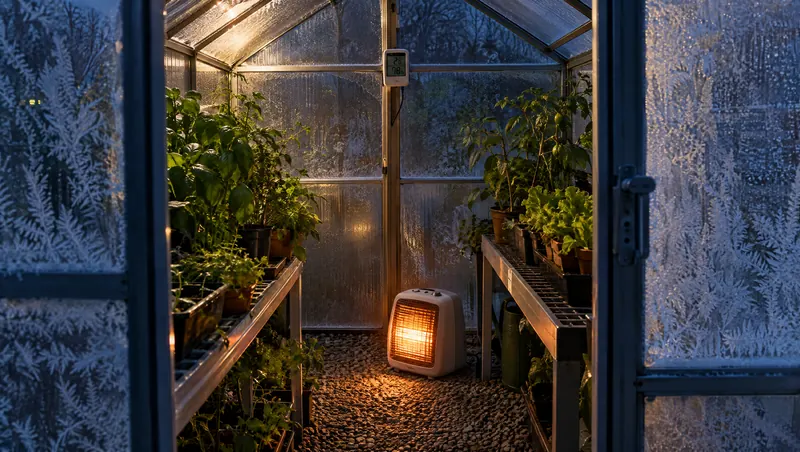
For most hobby kits up to about 130 sq ft, the best greenhouse heater is the Bio Green Palma with digital thermostat: 1,500 W on a normal 120 V outlet, splash-proof (IPX4), with a fan-only mode for summer. On a tighter budget, the Dr. Infrared DR-218 1500 W is also IPX4 and costs $101–$120. For 8x12 and larger houses you usually need more than one 120 V heater can give, so run the DR-218 3000 W or Bio Green Phoenix on a 240 V circuit. Propane (Mr. Heater Big Buddy) is for backup and power cuts only, and always with a vent open. Pair any plug-in heater with a controller that can carry its load: the bayite BTC211 (15 A) handles 1,500 W; the popular Inkbird ITC-308 (10 A) does not.
- 1Best electric greenhouse heaterBio Green Palma (Digital)
Small hobby greenhouses on a normal 120 V outlet that need frost protection in winter and air circulation in summer.
$172–$199typical, Oct 2026 - 2Best budget electricDr. Infrared DR-218 (1,500 W)
Small greenhouses on a standard 120 V outlet where you want a cheaper alternative to the Bio Green Palma.
$101–$120typical, Oct 2026 - 3Best for larger greenhouses (240 V)Dr. Infrared DR-218 (3,000 W)
Larger hobby greenhouses with a 240 V / 20 A circuit, at a low cost per watt.
$99–$130typical, Oct 2026 - 4Best 240 V with frost modeBio Green Phoenix PHX 2.8
Mid-size hobby greenhouses that have a 240 V circuit.
$299–$300typical, Oct 2026 - 5Best with humidity controlPalram HG1040 Fan Heater
Palram/Canopia owners who want heating and humidity control from one unit.
$509typical, Oct 2026 - 6Best propane backupMr. Heater Big Buddy (propane)
Emergency or backup heat for an off-grid or unpowered greenhouse.
$159–$240typical, Oct 2026 - 7Best thermostat for 1,500 W heatersbayite BTC211 Temperature Controller
Running a full 1,500 W greenhouse heater, which needs more headroom than the ITC-308's 10 A.
$36typical, Oct 2026 - 8Best controller for heater plus fan (under 10 A)Inkbird ITC-308 Controller
Adding a precise thermostat to a plug-in heater, or running a heater and an exhaust fan from one controller.
$36typical, Oct 2026
A greenhouse heater has a harder job than a space heater in a garage: the walls are thin, the air is humid, and plants die if it fails on the coldest night. So we picked on four things: a water-splash rating, a real thermostat, enough output for the house (sized with the formula below, not by guess), and an honest fit with the power you have. We compared manufacturer spec sheets, retailer listings and owner reviews. We haven't run these heaters ourselves; here's how we research.
The best greenhouse heaters
Bio Green Palma (Digital)
The Palma is built for greenhouses rather than borrowed from the garage aisle: stainless-steel housing, IPX4 splash protection, two elements (750 W or 1,500 W) and a digital thermostat, so you set a temperature instead of guessing on a dial. Bio Green says it suits up to 130 sq ft with a 6.6 ft average ceiling, which covers a twin-wall 6x8 greenhouse on cold nights and an 8x10 in milder winters. In summer the fan-only mode moves air without heat. It has 3,391 Amazon ratings averaging 4.0 stars.
Why it stands out
- IPX4 and stainless housing, made for humid air
- Digital setpoint plus a 750 W low setting to save power in mild spells
- Fan-only circulation mode for year-round use
Watch out for
- Listings disagree on coverage (120 vs 130 sq ft) and thermostat range
- Still a single 1,500 W heater: not enough on its own for an 8x12 single-wall house in a hard freeze
Full specs
- Key specs
- 120 V; two heating elements, 750 W or 1,500 W; 5,120 BTU/h on the maker's page (Amazon title says 5,100 BTU/h); Thermo 2 digital thermostat; fan-only air-circul
Specs from amazon.com, biogreen-products.com. Prices checked Oct 2026 and change often.
Dr. Infrared DR-218 (1,500 W)
The DR-218 gives you the same 1,500 W (about 5,118 BTU/h by the EIA conversion) and the same IPX4 splash rating as the Palma for a lower price. It is a steel fan-forced heater with an adjustable thermostat, over-heat protection and a sealed ball-bearing motor. It plugs into a standard NEMA 5-15 outlet. If you want a digital setpoint, put it on an external controller rated for 15 A.
Why it stands out
- IPX4 at a budget price
- Over-heat protection and an enclosed motor
- 882 Amazon ratings averaging 4.2 stars (shared with the 3000 W version)
Watch out for
- Dr. Infrared publishes no heated-area figure
- The dial thermostat is less precise than a digital one
Full specs
- Key specs
- 1,500 W at 120 V (NEMA 5-15 plug); fan-forced; adjustable thermostat with precision sensor; built-in over-heat protection; IPX4 (protected against water splashi
Specs from drheaterusa.com, drheaterusa.com. Prices checked Oct 2026 and change often.
Dr. Infrared DR-218 (3,000 W)
Our sizing table shows that an 8x12 or 10x12 house with single-wall panels needs more than 10,000 BTU/h on a cold night. One 120 V circuit can't deliver that, so the practical answer is a 240 V heater. The 3000 W DR-218 puts out about 10,236 BTU/h and is often priced about the same as the 1500 W model. You need a 240 V NEMA 6-20 receptacle, which means an electrician unless one is already there.
Why it stands out
- Twice the output of any 120 V plug-in
- Very low cost per watt
- IPX4 and over-heat protection
Watch out for
- Needs a 240 V / 20 A circuit with a NEMA 6-20 outlet
- No published heated area
Full specs
- Key specs
- 3,000 W at 240 V (NEMA 6-20 plug); fan-forced; adjustable thermostat; over-heat protection; IPX4; steel housing. 3,000 W is about 10,236 BTU/h (EIA conversion).
Specs from drheaterusa.com, drheaterusa.com. Prices checked Oct 2026 and change often.
Bio Green Phoenix PHX 2.8
The Phoenix is Bio Green's bigger greenhouse heater: 2,800 W across two elements (1,000 W and 1,800 W), about 9,554 BTU, a stepless thermostat and a 53 W fan mode. Bio Green rates it for up to 215 sq ft at a 6.6 ft average height. The two elements let it run on 1,000 W in mild weather. Choose it over the cheaper DR-218 3000 W if you want a greenhouse-specific unit with a low-power fan mode for summer.
Why it stands out
- Three heat levels from two elements
- Rated area published (215 sq ft)
- Low-draw fan mode for circulation
Watch out for
- 240 V only: it will not plug into a standard US outlet
- Thermostat tops out at 79°F, so it is not for hot-house tropicals
Full specs
- Key specs
- 240 V / 60 Hz only; two elements of 1,000 W and 1,800 W, 2,800 W combined; 9,554 BTU (Amazon title: 9,553 BTU); stepless thermostat from -58°F to 79°F; 53 W air
Specs from biogreen-products.com, amazon.com. Prices checked Oct 2026 and change often.
Palram HG1040 Fan Heater
Palram-Canopia's own heater pairs a 1,500 W / 5,500 BTU element with a digital thermostat and a humidity controller, each on its own 6.2 ft sensor cable, so you can put the sensors at plant height away from the heater. It is IPX4 and UL listed, with an auto-reset overheat limit. It does the same heating job as a Palma and costs roughly 2.5 to 3 times as much; you pay for the humidity control and the matching brand.
Why it stands out
- Separate remote sensors for temperature and humidity
- IPX4, UL and CE approved
- Made by the maker of the most common kit greenhouses
Watch out for
- Expensive for 1,500 W of heat
- Same output ceiling as any 120 V heater
Full specs
- Key specs
- 1,500 W / 5,500 BTU; digital thermostat and humidity controller; two sensors on separate cables; IPX4 splash resistance; stainless-steel heating element; auto-r
Specs from divetogarden.com, planetgreenhouse.com. Prices checked Oct 2026 and change often.
Mr. Heater Big Buddy (propane)
When the power fails on a freezing night, an electric heater is useless. The Big Buddy runs at 4,000, 9,000 or 18,000 BTU/h on two 1 lb cylinders or a 20 lb tank with a hose. It has an oxygen depletion sensor and a tip-over shut-off. The manual allows it only in an enclosure with a window or roof vent and at least 18 sq in of vent area, and says not to run other fuel-burning appliances inside. Treat it as emergency or backup heat, not your main heater (see the safety section below).
Why it stands out
- Works with no electricity at all
- ODS and tip-over shut-off
- 4.6 stars from 3,616 Amazon ratings
Watch out for
- Combustion adds moisture, carbon monoxide and ethylene; venting cuts the heat you get
- Mr. Heater removed the fan from some units; Amazon showed a 1 to 2 month shipping wait
- Sale restricted in Massachusetts and Canada
Full specs
- Key specs
- Propane; 4,000 / 9,000 / 18,000 BTU/h (low/medium/high); heats up to 450 sq ft; Oxygen Depletion Sensor (ODS) and accidental tip-over shut-off; runs on two 1 lb
Specs from amazon.com, mrheater.com. Prices checked Oct 2026 and change often.
bayite BTC211 Temperature Controller
A plug-in controller turns a dial heater into a precise one: the heater stays on high and the controller switches the outlet at your setpoint, read by a probe at plant height. The BTC211 is listed at 1,650 W / 15 A, which leaves headroom for a 1,500 W heater (12.5 A at 120 V). Its two outlets can run heating and cooling stages, so a fan can come on when the house overheats. Specs come from the listing; read the manual for the outlet limits before you load both sides.
Why it stands out
- 15 A rating covers a full 1,500 W heater
- Heating and cooling outlets in one box
- 4.5 stars from 1.4K Amazon ratings
Watch out for
- We have only the listing specs, not the manual
- No WiFi or phone alerts
Full specs
- Key specs
- Plug-in pre-wired controller; 1,650 W / 15 A; listing titles describe dual outlets with 2-stage heating and cooling.
Specs from amazon.com, amazon.com. Prices checked Oct 2026 and change often.
Inkbird ITC-308 Controller
The ITC-308 is the best-known plug-in controller, with separate heat and cool relays, ±2°F accuracy, high/low alarms and a 6 ft probe. The catch for greenhouse use: its output is rated at 10 A, which is about 1,100 to 1,200 W at 110 to 120 V. A 1,500 W heater exceeds that. Use it for a heater locked on its 750 W setting, a heat mat bank, or an exhaust fan; use the bayite for a full 1,500 W heater. A WiFi version (ITC-308-WIFI) exists, but we did not read its separate spec sheet.
Why it stands out
- Separate heating and cooling relays with alarms
- Calibration and 0.1° resolution
- 10.3K Amazon ratings averaging 4.6 stars
Watch out for
- 10 A maximum: not for 1,500 W heaters
- No phone alerts on the standard model
Full specs
- Key specs
- Dual relay outputs (one for heating, one for cooling); control range -58 to 248°F; ±2°F accuracy (-58 to 160°F); 0.1° resolution; output max 10 A at 100–240 V A
Specs from inkbird.com, amazon.com. Prices checked Oct 2026 and change often.
Compare greenhouse heaters and controllers
| Model | Key specs | Typical price | Best for | Shop |
|---|---|---|---|---|
| Palma Electric Greenhouse Heater & Fan, Digital Thermostat (Thermo 2) | 120 V; two heating elements, 750 W or 1,500 W; 5,120 BTU/h on the maker's page (Amazon title says 5,100 BTU/h); Thermo 2 digital thermostat; fan-only air-circulation mode; 5,800 ft³/h airflow; IPX4 splash-proof; stainless-steel housing. Maker's page says it suits rooms up to 130 ft² with a 6.6 ft average ceiling. | $172–$199 | Small hobby greenhouses (about 130 ft² or less) on a normal 120 V outlet that need frost protection in winter and air circulation in summer. | Amazon |
| DR-218 Greenhouse Garage Workshop Heater, 1500 W (120 V) | 1,500 W at 120 V (NEMA 5-15 plug); fan-forced; adjustable thermostat with precision sensor; built-in over-heat protection; IPX4 (protected against water splashing); heavy-duty steel housing; enclosed, thermally protected ball-bearing motor; 13 lb. 1,500 W is about 5,118 BTU/h (1 kWh = 3,412 Btu per EIA). | $101–$120 | Small greenhouses on a standard 120 V outlet where you want a cheaper alternative to the Bio Green Palma. | Amazon |
| DR-218 Greenhouse Garage Workshop Heater, 3000 W (240 V) | 3,000 W at 240 V (NEMA 6-20 plug); fan-forced; adjustable thermostat; over-heat protection; IPX4; steel housing. 3,000 W is about 10,236 BTU/h (EIA conversion). | $99–$130 | Larger hobby greenhouses with a 240 V / 20 A circuit, at a low cost per watt. | Amazon |
| Phoenix PHX 2.8/US Greenhouse Heater & Fan (240 V) | 240 V / 60 Hz only; two elements of 1,000 W and 1,800 W, 2,800 W combined; 9,554 BTU (Amazon title: 9,553 BTU); stepless thermostat from -58°F to 79°F; 53 W air-circulation (fan) mode; maker's page says it suits up to 215 ft² with a 6.6 ft average height; Amazon title mentions frost detection. | $299–$300 | Mid-size hobby greenhouses (about 215 ft² or less) that have a 240 V circuit. | Amazon |
| 1500W/5500 BTU Greenhouse Fan Heater with Digital Thermostat & Humidity Sensor (HG1040) | 1,500 W / 5,500 BTU; digital thermostat and humidity controller; two sensors on separate cables; IPX4 splash resistance; stainless-steel heating element; auto-reset safety limit that shuts down on overheating; UL and CE approved; two 2 m (6.2 ft) cables. | $509 | Palram/Canopia owners who want heating and humidity control from one unit. | Dive to Garden |
| Big Buddy Portable Propane Heater (MH18B / Amazon 'PRO Series') | Propane; 4,000 / 9,000 / 18,000 BTU/h (low/medium/high); heats up to 450 sq ft; Oxygen Depletion Sensor (ODS) and accidental tip-over shut-off; runs on two 1 lb cylinders or a 20 lb tank with an optional hose; maximum elevation 7,000 ft; 17.1 lb (maker's page). Amazon bullets add a built-in fan and 'up to 216 hrs on two 20 lb tanks (low setting)'. | $159–$240 | Emergency or backup heat for an off-grid or unpowered greenhouse. | Amazon |
| BTC211 Dual-Outlet Temperature Controller 1650W 15A | Plug-in pre-wired controller; 1,650 W / 15 A; listing titles describe dual outlets with 2-stage heating and cooling. | $36 | Running a full 1,500 W greenhouse heater, which needs more headroom than the ITC-308's 10 A. | Amazon |
| ITC-308 Digital Temperature Controller (dual-stage plug-in) | Dual relay outputs (one for heating, one for cooling); control range -58 to 248°F; ±2°F accuracy (-58 to 160°F); 0.1° resolution; output max 10 A at 100–240 V AC; NTC probe on a 6 ft lead; high/low temperature alarms; compressor-delay protection; calibration (maker's spec block). | $36 | Adding a precise thermostat to a plug-in heater, or running a heater and an exhaust fan from one controller. | Amazon |
What size greenhouse heater do I need?
Don't size by floor area alone. University of Alaska Fairbanks Extension (UAF) uses this formula, credited to Kramer (2013), because it accounts for how much glazing the heat escapes through:
Heat loss (BTU/h) = surface area of walls + roof (sq ft) × U-value of the cover × temperature lift (°F). The temperature lift is the gap between the lowest inside temperature you want and the coldest outside night you plan for. Size on the heater's output. For electric heaters, 1 W = 3.412 BTU/h, so watts = BTU/h ÷ 3.412.
U-values from UAF's table (BTU/h per sq ft per °F): single glass, single polycarbonate and fiberglass 1.2; single plastic film 1.25; double film 0.8; double (twin-wall) polycarbonate or acrylic 0.6. Palram's own SUNLITE figures for bare 4 mm twin-wall convert to about 0.67, so a kit like the Palram Mythos sits close to UAF's 0.6. Clear single-wall panels, as on the Hybrid's walls or Snap & Grow, behave like 1.2.
Worked examples: 6x8, 8x12 and 10x12
Our calculation (not a manufacturer figure) assumes a simple gable house: 5 ft eaves with a 7 ft peak for the 6x8, a 7.5 ft peak for the 8x12, and 5.5 ft eaves with an 8 ft peak for the 10x12. Surface area = side walls + end walls + gable triangles + both roof slopes. For the 6x8: 80 + 60 + 12 + 57.7 = about 210 sq ft. The 8x12 comes to about 333 sq ft and the 10x12 to about 401 sq ft. Check your own kit's dimensions; taller houses have more surface.
| Size (surface) | Cover (U) | Lift 20°F | Lift 30°F | Lift 40°F |
|---|---|---|---|---|
| 6x8 (210 sq ft) | Twin-wall poly (0.6) | 2,516 BTU/h · 737 W | 3,774 BTU/h · 1,106 W | 5,033 BTU/h · 1,475 W |
| 6x8 (210 sq ft) | Single wall/glass (1.2) | 5,033 BTU/h · 1,475 W | 7,549 BTU/h · 2,212 W | 10,065 BTU/h · 2,950 W |
| 8x12 (333 sq ft) | Twin-wall poly (0.6) | 3,998 BTU/h · 1,172 W | 5,998 BTU/h · 1,758 W | 7,997 BTU/h · 2,344 W |
| 8x12 (333 sq ft) | Single wall/glass (1.2) | 7,997 BTU/h · 2,344 W | 11,995 BTU/h · 3,516 W | 15,994 BTU/h · 4,688 W |
| 10x12 (401 sq ft) | Twin-wall poly (0.6) | 4,814 BTU/h · 1,411 W | 7,221 BTU/h · 2,116 W | 9,628 BTU/h · 2,822 W |
| 10x12 (401 sq ft) | Single wall/glass (1.2) | 9,628 BTU/h · 2,822 W | 14,442 BTU/h · 4,233 W | 19,256 BTU/h · 5,644 W |
How to read it: a twin-wall 6x8 that must stay at 40°F on a 0°F night needs a 40°F lift, so 210 × 0.6 × 40 = 5,033 BTU/h, or 1,475 W. One 1,500 W heater just covers it, with no margin. The same house kept at 40°F when it is 20°F outside needs only half that. A single-wall 8x12 needing a 30°F lift is at 11,995 BTU/h, beyond even a 3,000 W heater, so add bubble insulation (see our winter greenhouse guide) or a second heater.
The formula ignores heat lost through the base and floor and through gaps around doors and vents, so UAF's advice applies: a slightly oversized heater is always better than an undersized one, and a backup heater is worth having. Choosing a twin-wall polycarbonate kit halves the heat you need compared with single-wall panels.
How much does it cost to run a greenhouse heater?
Electric heat is simple to price. A 1,500 W heater uses 1.5 kWh per hour it runs. At the US average residential price of 18.31¢/kWh in July 2026 (EIA), that is about $0.27 an hour. Prices vary a lot by state: 14.71¢ in Washington and 48.00¢ in Hawaii in the same month.
| Heater | Per hour running | 10 h a night | 30 nights at 10 h |
|---|---|---|---|
| 750 W (Palma low) | $0.14 | $1.37 | $41 |
| 1,500 W | $0.27 | $2.75 | $82 |
| 3,000 W (240 V) | $0.55 | $5.49 | $165 |
(calc at 18.31¢/kWh.) A thermostat cycles the heater on and off, so actual run hours depend on your nights and insulation; the table is the cost of each hour the element is on. Propane compares on burn rate: Mr. Heater lists the Portable Buddy at 0.044 gal/h on 4,000 BTU and 0.099 gal/h on 9,000 BTU. For a full budget, including the kit and base, see what a greenhouse really costs.
Electric vs propane vs gas: which greenhouse heater type?
- Electric fan heaters (most hobby greenhouses). No fumes, no moisture added, easy thermostat control. Limited to about 1,500 W per 120 V circuit, or about 3,000 W on 240 V. Choose IPX4 or better.
- Propane portables. Work without power, so they are good backup. RHS notes that burning gas or paraffin (kerosene) releases water, ethylene and carbon monoxide, so the house must be vented, which cuts the heating effect. RHS considers such heaters useful mainly for plants that tolerate low temperatures. A 1 lb cylinder will not last a winter night on high.
- Vented gas unit heaters. For larger, year-round houses with a gas line, a vented unit such as the Modine Hot Dawg HD30 (24,600 BTU/h output, rated for greenhouses up to 250 sq ft) sends combustion gases outside through a flue. It is a professional install, and the heater alone costs many times a plug-in unit.
- Hardwired electric. A unit heater like the King KBP Series 2 (950 to 6,000 W, wall or ceiling mount) frees floor space and runs on a dedicated circuit, but needs an electrician.
We left kerosene heaters out on purpose: they share propane's combustion problems and add fuel storage and odor.
Greenhouse heater safety: power, cords, clearances and fumes
- Use a GFCI outlet. Water and electricity meet in a greenhouse. Plug into a GFCI-protected outdoor receptacle and keep plugs above splash level.
- Skip the extension cord. A 1,500 W heater draws about 12.5 A continuously. Thin or long cords overheat. If the greenhouse is far from an outlet, have an electrician run a weatherproof circuit; for 240 V heaters this is required anyway.
- Keep clearances. Keep the heater well away (3 ft is the common rule) from plastic film, shade cloth, seed trays and anything that can burn, on a level, non-flammable surface where it cannot be knocked over or sprayed by the hose.
- Vent combustion heaters, every time. For propane, follow the manual's vent rule (the Big Buddy needs at least 18 sq in open) and never run it in a sealed house overnight. Use a battery carbon monoxide alarm if you enter while it runs. Ethylene can harm sensitive plants, a reason to prefer electric as the main heater.
- Measure where the plants are. RHS warns that built-in thermostat dials can be a few degrees off because they sit close to the heater. Put a max/min thermometer or a WiFi sensor such as the Govee H5179 at plant height in the middle of the house; it can alert your phone before the house freezes.
Cheap milkhouse heaters such as the Comfort Zone CZ798BK are sold "for garage or greenhouse", but the listing we read gives no splash (IP) rating. In a humid greenhouse we'd pay more for an IPX4 heater like the DR-218.
Heat mats: the cheaper way to heat seedlings
If you only need warmth for seed starting in spring, heating the soil is far cheaper than heating the air. Hydrofarm says Jump Start mats warm the root zone 10 to 20°F above the surrounding air, and Bootstrap Farmer recommends holding soil at 65 to 80°F for germination. The one-flat Jump Start MT10006 uses 17 W, against 1,500 W for an air heater. For a full bench, the Bootstrap Farmer 60x21 in commercial mat (150 W) daisy-chains up to four mats.
Run mats through a thermostat so the soil doesn't cook: the Bootstrap Farmer mat controller handles up to 1,000 W but only goes down to 68°F, so it is for germination, not frost protection. Mats sit nicely on the benches in our greenhouse shelving guide.
How to choose a greenhouse heater
- Output vs heat loss. Run the formula above for your coldest typical night. If the answer is over about 5,000 BTU/h, one 120 V heater isn't enough.
- Power available. A 120 V outlet tops out around 1,500 W. More means 240 V or two separate circuits.
- Splash rating. IPX4 means protected against splashing water. The Palma, DR-218 and Palram HG1040 all list it.
- Thermostat. Digital is easier to trust; or add an external controller rated above the heater's amps.
- Fan mode. A heater with a fan-only setting doubles as summer circulation. For exhaust fans and vents, see our greenhouse ventilation guide.
- Backup. In real freezes, keep a second heat source: a propane unit for power cuts, or a second electric heater on another circuit.
Mistakes to avoid
- Sizing by floor area alone. A tall, single-wall house loses far more heat than its floor suggests.
- Putting a 1,500 W heater on a 10 A controller. The ITC-308's 10 A rating is below a 1,500 W heater's draw.
- Running propane in a sealed house. It adds moisture, carbon monoxide and ethylene. Vent it, every time.
- Trusting the dial. Read the temperature at plant height, not at the heater.
- Heating leaks. Gaps around doors and vents, and bare single-wall panels, cost more than any heater upgrade saves. Insulate before you buy a bigger heater, and make sure the house is anchored on a sealed greenhouse foundation.
Frequently asked questions
What size heater do I need for my greenhouse?
Multiply the surface area of walls plus roof (sq ft) by the cover's U-value and by the temperature lift you need (°F). A twin-wall 6x8 kit holding 40°F on a 0°F night needs about 5,000 BTU/h, which is one 1,500 W electric heater. Add a margin; extension advice is that slightly oversized beats undersized.
How many BTU does a 1,500 W heater put out?
About 5,118 BTU/h. One kilowatt-hour equals 3,412 Btu (EIA), so every watt of an electric heater gives about 3.4 BTU/h, and a 3,000 W heater gives about 10,236 BTU/h.
How much does it cost to run a greenhouse heater?
A 1,500 W heater uses 1.5 kWh per hour it runs, about $0.27 an hour at the July 2026 US average of 18.31¢/kWh (EIA). Ten hours a night for 30 nights is about $82. A thermostat cycles the heater, so real costs depend on your weather and insulation.
Is it safe to use a propane heater in a greenhouse?
Only with ventilation. Burning propane releases water vapor, carbon monoxide and ethylene, which can harm plants. The Mr. Heater Big Buddy manual requires a window or roof vent with at least 18 sq in of opening and no other fuel-burning appliances inside. Treat propane as backup heat, never as a sealed overnight heater.
Can I plug a greenhouse heater into an extension cord?
Avoid it. Plug the heater directly into a GFCI-protected outdoor outlet on a circuit that can carry the load. If the greenhouse is far from power, have an electrician run a proper circuit rather than chaining cords across the yard.
What temperature should I keep my greenhouse at in winter?
Frost-free (about 39°F / 4°C) is enough to overwinter tender plants, per the RHS. Warm-season crops and seed starting need much more heat, which is where heat mats are far cheaper than heating the whole air volume.
Keep reading
 Growing guideWinter greenhouse guideKeep a greenhouse productive in winter: what to grow, how big a heater you need, insulation, thermal mass and safety.
 GearGreenhouse fans and ventsExhaust fans, automatic vent openers and shade cloth, sized with the 12 CFM per sq ft rule for hobby greenhouses.
 Kits by typePolycarbonate greenhouse kitsTwin-wall vs clear panels, thickness and R-values, plus six aluminum hobby kits from starter 6x8s to snow-country builds.
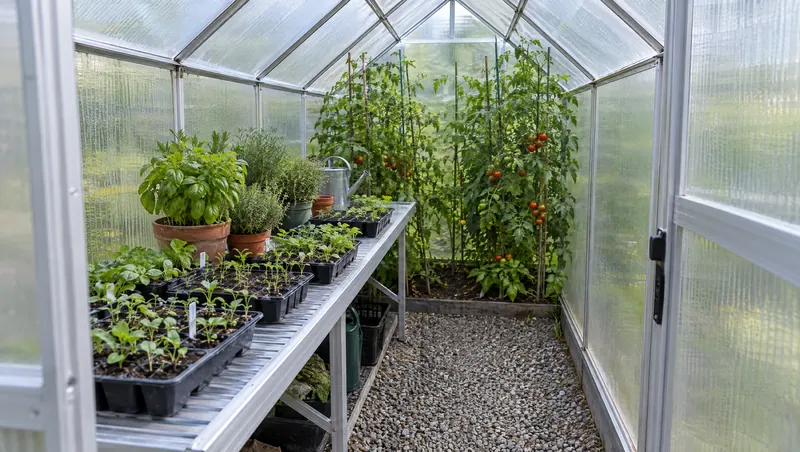 Kits by size6x8 greenhouse kitsBest 6x8 kits, how many flats and tomato plants fit, and when to size up to 8x8 or 6x10.
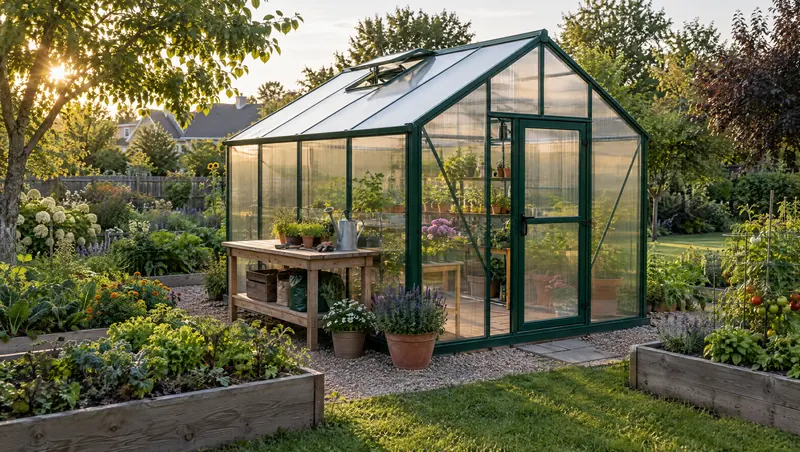 Kits by size10x12 greenhouse kits10x12 kits from a hoop house to a garden room, with the real cost of the base, anchors and extras.
 Cost guideHow much a greenhouse costsGreenhouse prices by type and size, cost per square foot, the hidden extras and what heating really costs per night.